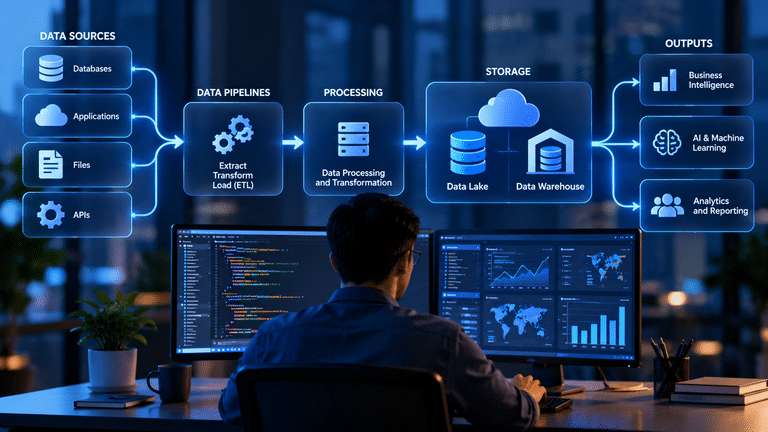

MLOps, or machine learning operations, is a set of practices that helps teams develop, deploy, monitor, and maintain machine learning models reliably. It connects model development with software engineering and operational processes.
- MLOps makes model deployment and updates more consistent.
- Automation, version control, testing, and monitoring support reliable machine learning systems.
- Clear ownership helps teams manage model performance throughout its lifecycle.
MLOps helps businesses move machine learning models from experiments into dependable, real-world applications. Building a model is only one step. Teams must also deploy it, track its performance, manage data changes, and update it when business needs evolve.
Understanding MLOps is important for organizations investing in artificial intelligence and predictive analytics. By combining machine learning workflows with operational discipline, teams can improve repeatability, identify problems earlier, and manage models after launch.
What Does MLOps Mean?
MLOps stands for machine learning operations. It applies ideas from DevOps, such as automation, collaboration, and continuous delivery, to the lifecycle of machine learning systems.
MLOps can cover data preparation, experiment tracking, model training, testing, deployment, monitoring, and retraining.
Why Is MLOps Important?
A model may perform well during development but produce weaker results when real-world data changes. Without monitoring, teams may not notice the decline quickly.
MLOps introduces repeatable workflows and clear checks. Teams can track which data and model versions were used, test changes before release, and respond when performance or infrastructure issues appear.
This is useful when models support recurring business processes and must remain understandable, testable, and dependable as systems and data evolve.
How Does an MLOps Workflow Work?
A typical workflow begins with preparing and validating data. Data scientists or machine learning engineers train a model and record its configuration, results, and relevant versions. Automated tests can check code, data quality, and model behavior before deployment.
After approval, the model is released into an application or service. Monitoring then tracks operational measures, such as response time and failures, as well as model-related measures where reliable feedback is available. When data patterns or requirements change, the team can investigate and retrain or redeploy the model through a controlled process.
Which Practices Support MLOps?
| Practice | Why it matters |
| Version control | Tracks code, data, and model changes |
| Automated testing | Finds issues before release |
| Continuous integration and delivery | Makes updates more repeatable |
| Monitoring | Helps identify performance or service problems |
| Documentation | Supports review and troubleshooting |
What Challenges Should Businesses Consider?
MLOps can require new tools, skills, and coordination between data science, engineering, security, and operations teams. Poor data quality, unclear ownership, and limited monitoring can undermine the process. Automating an unstable workflow may simply make errors happen faster.
Businesses should also consider privacy, access controls, audit needs, and the cost of maintaining infrastructure.
How does Dhaka Technologies Ltd. Company help?
Dhaka Technologies Ltd. is a Washington, DC-based IT solutions and staff augmentation provider serving government and private-sector organizations. DTLC provides staff augmentation across roles including software development, cloud engineering, cybersecurity, data engineering, AI, project management, network engineering, GIS, and unified communications, giving US teams a way to add targeted technical capacity without treating every short-term need as a permanent hire.
DTLC’s staff augmentation model is designed for teams that want to remain involved in the work and retain control over their projects. The company also provides IT consulting, cloud implementation and migration, software development and testing, cybersecurity, and other technology services.
For example, if your team needs additional cloud expertise, DTLC offers cloud engineering staff augmentation for AWS, Azure, and Google Cloud environments. If your immediate need is AI expertise, DTLC also offers AI engineer augmentation across junior, mid-level, senior, and architect-level roles.
For related information, see Dhaka Technologies Ltd. Company’s Staff Augmentation.
Conclusion
MLOps provides a structured way to build, release, monitor, and maintain machine learning systems. By combining automation, versioning, testing, and ongoing oversight, businesses can make model operations more manageable. A practical MLOps approach should fit the use case, team, and risks involved.
Frequently Asked Question
1. Is MLOps the same as DevOps?
No. MLOps shares DevOps practices but also addresses machine learning needs, including data validation, model evaluation, and model performance monitoring.
2. Does every machine learning project need MLOps?
Not every project needs a full MLOps platform. However, projects used in production generally benefit from appropriate testing, version control, monitoring, and ownership.
3. Which tools are used for MLOps?
Tools vary. Teams may use version control, experiment tracking, workflow orchestration, automated deployment, and monitoring tools suited to their existing systems.
4. Who is responsible for MLOps?
Responsibility is often shared by machine learning engineers, data scientists, software engineers, and operations teams.