
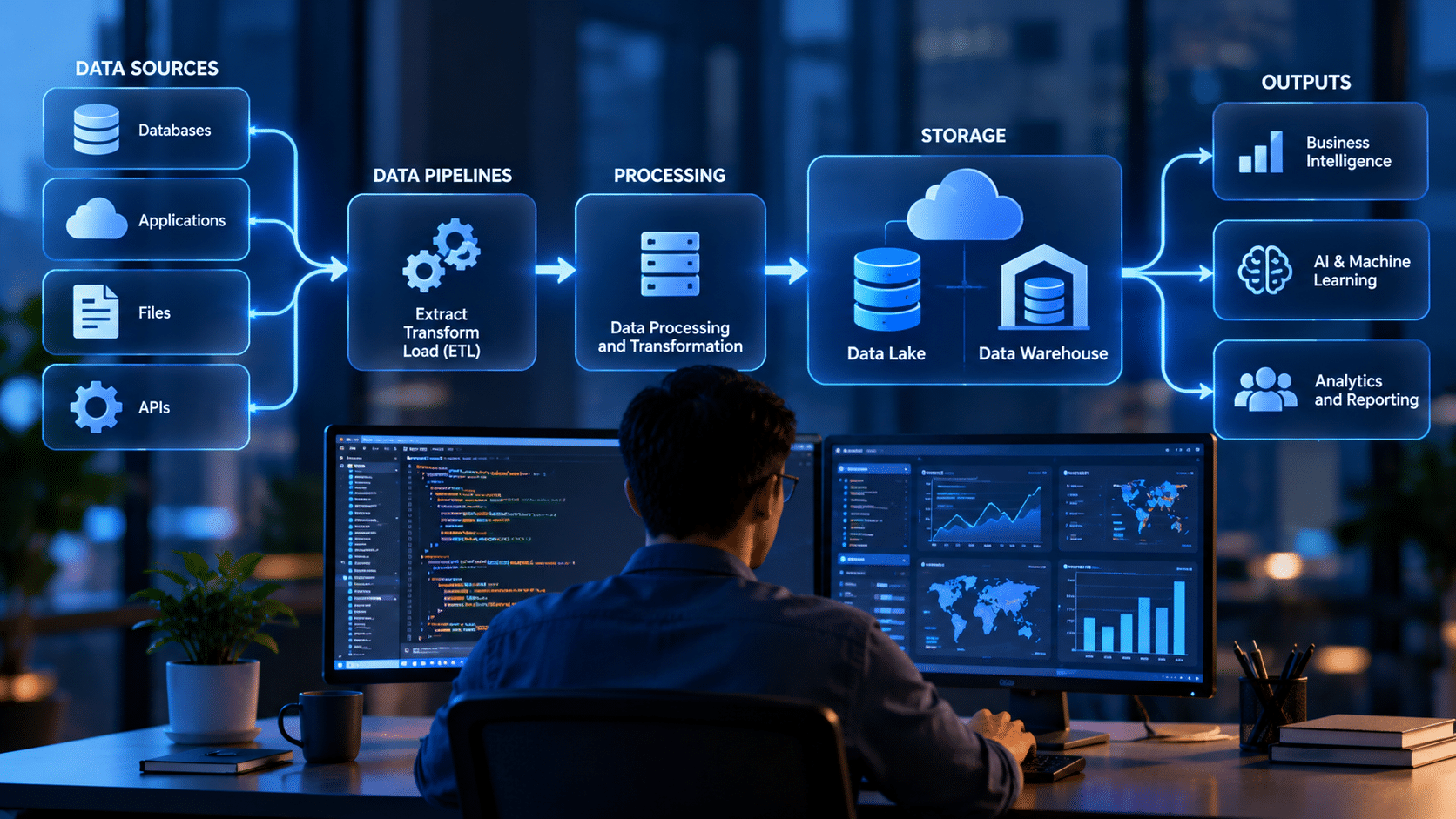
A data engineer designs, builds, and maintains systems that collect, transform, store, and deliver data. Their work ensures information from applications, databases, and other sources is reliable and ready for analytics, reporting, and artificial intelligence (AI) initiatives.
- Data engineers build and maintain data pipelines and infrastructure.
- They improve data quality, accessibility, reliability, and security.
- Common skills include SQL, Python, databases, cloud platforms, and data-processing tools.
- Their work supports analysts, data scientists, business teams, and AI applications.
If you’re asking, what is a data engineer?, the answer lies in how businesses collect and use information. Organizations generate data through websites, applications, customer systems, transactions, and operational tools. Without reliable systems to organize and move that information, teams may struggle with inconsistent reports, delayed insights, and disconnected data sources.
A data engineer builds the foundation that allows information to flow securely and consistently from its source to the people and systems that need it.
What Does a Data Engineer Do?
Data engineers create and maintain infrastructure used to collect, process, store, and distribute data. They build pipelines that bring information together from different systems, transform it into usable formats, and load it into a data warehouse or data lake.
Their responsibilities include integrating data sources, automating workflows, monitoring pipeline performance, fixing data errors, improving processing efficiency, and managing access controls.
For example, a retailer may need sales, inventory, and customer information combined for reporting. A data engineer can build a pipeline that brings those sources together and keeps the resulting dataset updated.
Which Skills and Tools Matter?
Data engineers commonly need SQL, programming experience—often with Python—and an understanding of databases and data modeling. Depending on the environment, they may also use cloud platforms, data warehouses, orchestration tools, and distributed processing frameworks.
Important capabilities include:
- Data pipelines: Building reliable workflows for moving and transforming information.
- Data modeling: Organizing data so it can be queried consistently.
- Cloud platforms: Working with cloud storage, computing, and managed data services.
- Data quality: Detecting missing, duplicated, outdated, or inconsistent records.
- Security and governance: Supporting appropriate access, documentation, and data handling.
The right toolset depends on the company’s architecture, data volume, security requirements, and existing technology stack.
Data Engineer vs. Data Analyst vs. Data Scientist
These roles work together but focus on different outcomes.
| Role | Main Focus |
| Data Engineer | Builds and maintains data infrastructure and pipelines |
| Data Analyst | Uses data to answer business questions and create reports |
| Data Scientist | Applies statistics and machine learning to investigate patterns and build predictive models |
A data engineer makes data available and dependable. Analysts interpret it to support decisions, while data scientists may use it for experimentation and predictive work. In smaller organizations, responsibilities can overlap.
When Does a Business Need a Data Engineer?
A business may need data engineering expertise when information is scattered across systems, reports require frequent manual preparation, pipelines fail regularly, or teams cannot access trusted data quickly.
Data engineers can also help when an organization is moving to the cloud, building a data warehouse, preparing data for AI, or scaling its analytics capabilities. Before hiring, businesses should define their data sources, expected data volumes, reliability needs, and intended business outcomes.
How does Dhaka Technologies Ltd. Company help?
Dhaka Technologies Ltd. is a Washington, DC-based IT solutions and staff augmentation provider serving government and private-sector organizations. DTLC provides staff augmentation across roles including software development, cloud engineering, cybersecurity, data engineering, AI, project management, network engineering, GIS, and unified communications, giving US teams a way to add targeted technical capacity without treating every short-term need as a permanent hire.
DTLC’s staff augmentation model is designed for teams that want to remain involved in the work and retain control over their projects. The company also provides IT consulting, cloud implementation and migration, software development and testing, cybersecurity, and other technology services.
For example, if your team needs additional cloud expertise, DTLC offers cloud engineering staff augmentation for AWS, Azure, and Google Cloud environments. If your immediate need is AI expertise, DTLC also offers AI engineer augmentation across junior, mid-level, senior, and architect-level roles.
For related information, see Dhaka Technologies Ltd. Company’s Staff Augmentation.
Conclusion
Understanding what is a data engineer helps businesses recognize the importance of reliable data infrastructure. Data engineers build and maintain the pipelines and systems that make information accessible, consistent, and useful for reporting, analytics, and AI.
By identifying data challenges, defining technical requirements, and selecting the right skills and workforce model, businesses can build a stronger foundation for data-driven decisions.
Frequently Asked Question
What is the main responsibility of a data engineer?
A data engineer builds and maintains systems that collect, transform, store, and deliver reliable data for other teams and applications.
Which programming languages do data engineers use?
SQL is essential in many roles, while Python is commonly used for automation and data processing. Requirements vary by platform and project.
Do data engineers work with AI teams?
Yes. They can prepare and maintain data pipelines that supply reliable information to machine learning and AI applications.
When should a business hire a data engineer?
Consider hiring one when data is fragmented, manual reporting is time-consuming, pipelines are unreliable, or the organization needs scalable data infrastructure.